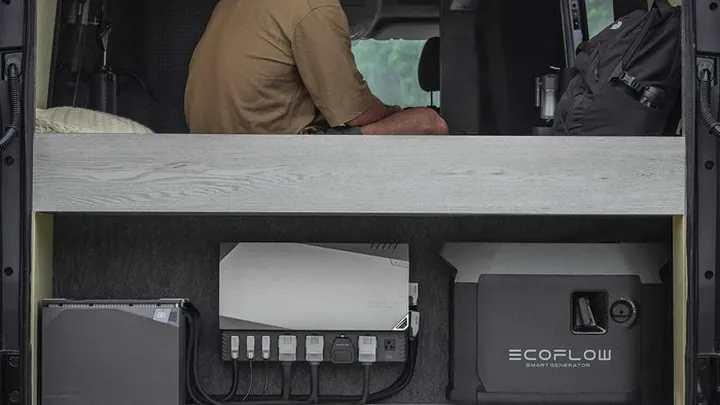
A camper van or RV electrical system answers four questions in a row: how much energy you use in a day, how much a battery can store, how much the roof and the alternator can put back, and how it is all protected. Most guides start with a kit. We start with your loads, because the fridge alone can swing the answer from a small battery to a large bank.
We read the public catalogs and product pages of seven US brand stores (BougeRV, Renogy, ICECO, Battle Born, EcoFlow, BLUETTI and ALLPOWERS) and kept 86 products: 12V compressor fridges, house batteries, solar panels, charge controllers, DC-DC chargers and portable power stations. Prices were read on November 10, 2026. For each one we kept the price shown that day and the figures its maker publishes: watts, watt-hours, usable depth of discharge, panel size.
How we work. We read what the makers publish, quote it, and do the arithmetic in the open. When a figure is not published, we write "not published" and let you set it. Our own calculations are marked. Sun data comes from the National Laboratory of the Rockies (formerly NREL) Solar Resource API.
What we compared
| Family | Products | Stores | Price range |
|---|---|---|---|
| 12V compressor fridges | 30 | BougeRV, EcoFlow, ICECO, Renogy | $179.99 to $1,349 |
| 12V house batteries | 9 | Battle Born, BougeRV, Renogy | $208.99 to $2,299 |
| Solar panels | 15 | BougeRV, Renogy | $111.99 to $459.99 |
| MPPT solar charge controllers | 7 | BougeRV, Renogy | $87.99 to $399.99 |
| DC-DC and alternator chargers | 8 | BLUETTI, Battle Born, EcoFlow, Renogy | $143.65 to $328.10 |
| Portable power stations | 17 | ALLPOWERS, BLUETTI, BougeRV, EcoFlow | $139 to $1,499 |
Step 1: your daily watt-hours come first
Every load is watts times hours. A 10 W fan for 8 hours is 80 Wh. The 12V compressor fridge is the big one in most vans, and the hardest to pin down, because the compressor cycles on and off. Makers publish two kinds of figures:
- Rated watts, the draw while the compressor runs: 45 W to 80 W on the BougeRV pages we read, 60 W on Renogy's 42 qt fridge, 55 W on the EcoFlow GLACIER Classic.
- A daily figure, from a lab test: EcoFlow publishes "165wh/24h" as a fridge and "520wh/24h" as a freezer, at 77°F and in Eco mode; ICECO publishes "0.347kw.h/24" for the VL45 ("Laboratory data for reference only") and "0.293KW.H/24H" for the APL20.
BougeRV gives the worst case itself: its 53 qt fridge "would consume 1.44 kWh of energy if it runs continuously for 24 hours at Max Mode (60W)". That is 60 W x 24 h, and it is our default in the power budget until you lower the hours. Detail and all published figures: 12V fridge power consumption.
Step 2: the battery stores it, minus what you should not use
The number on a battery is its rated capacity. What you can draw depends on the chemistry and on what the maker allows. Battle Born publishes "Usable Depth of Discharge | 100%". Renogy writes of its AGM batteries that "it's recommended not to discharge the battery below 50%", so a 200Ah AGM gives you about 1,200 Wh. Renogy and BougeRV rate their lithium cycle life at 80% and 100% depth of discharge but publish no usable share, so our tools let you choose it (80% by default, the depth Renogy uses for its cycle-life figure). Comparison: RV lithium batteries and lithium vs AGM.
Step 3: solar and the alternator put it back
A panel's daily energy is roughly its watts times the peak sun hours where you park. On a flat roof, NLR data give 3.18 hours a day in Phoenix in December and 0.88 in Olympia, Washington (NLR Solar Resource API): a 200 W panel then makes about 636 Wh and 176 Wh a day before losses. That is why winter van life usually leans on the alternator too. Tools and guides: solar on the roof, how much solar for a camper van, DC-DC chargers.
Step 4: protect the system
Safety first. A 12V system stores enough energy to start a fire: battery cables carry far more current than household wiring, and a short across a lithium bank can melt tools. Every positive cable needs the right fuse or breaker close to the battery, lithium batteries need a charger set for their chemistry, and any fuel-burning heater or generator brings a carbon monoxide risk that calls for a working CO alarm. We do not publish wiring instructions. Have the system installed or checked by a qualified installer, follow each product manual, and for RVs the NFPA 1192 Standard on Recreational Vehicles, which "establishes fire and life safety criteria for recreational vehicles" (NFPA).
Where to go next
- Know your loads? Power budget, then what size battery for a 12V fridge.
- Planning the roof? Solar on the roof.
- Want no wiring at all? Portable power stations for van life.
- Backing up the house too? Whole-home backup power stations, and EcoFlow DELTA Pro vs BLUETTI Apex 300.
New on Rig Amps
- Run a refrigerator : Your fridge's yellow label gives the only number you need: kWh per year.
- Charge from a generator : Yes, through the AC charging cable: the generator has to cover the station's AC input watts.
- Use while charging : Most product pages now say yes, but the limits are in the small print.